
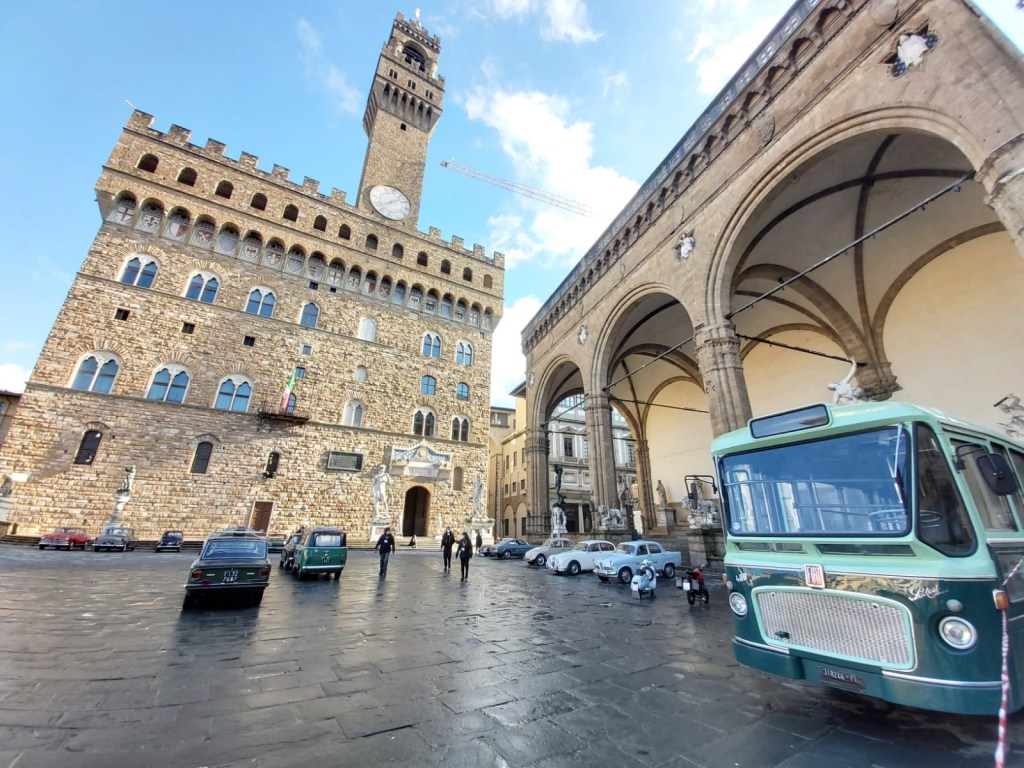
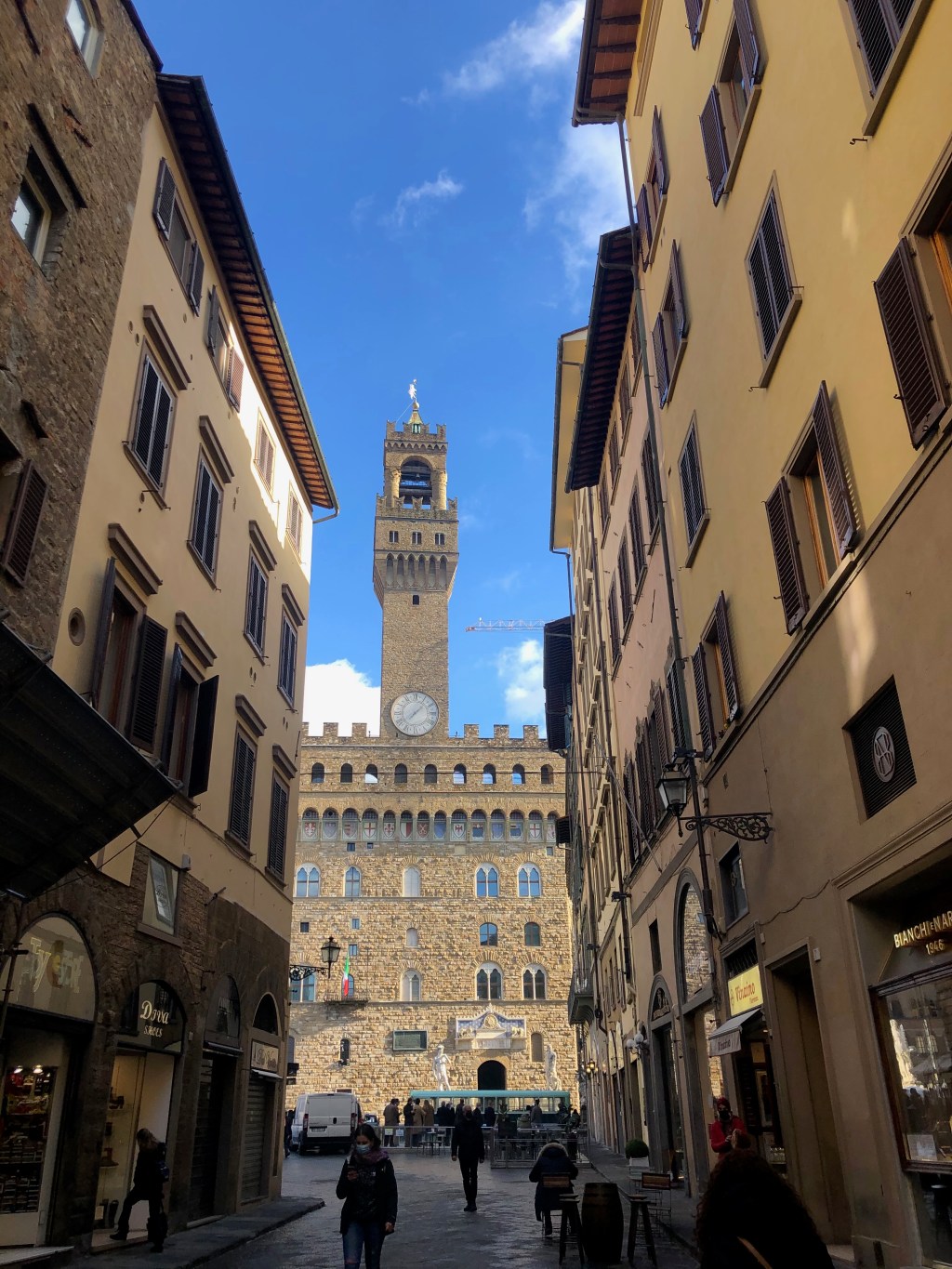
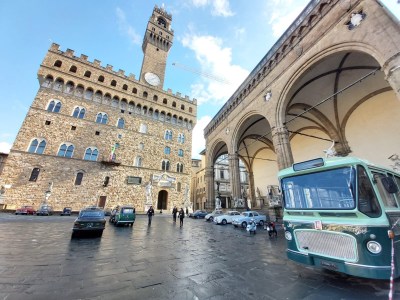
From the outside it looks like a medieval fortress; inside, it’s a royal palace. Palazzo Vecchio packs three hundred years of Florentine history into a single building: the city of the priors, Savonarola’s republic and the duchy of Cosimo I de’ Medici.
It’s still Florence’s town hall and, unlike the big state museums, it’s open on Mondays too.
At a glance
- Museum: Monday, Tuesday, Wednesday, Friday, Saturday and Sunday, 9 am to 7 pm; Thursdays, 9 am to 2 pm. Last entry one hour before closing. Allow an hour and a half.
- Arnolfo’s Tower and battlements walk: 9 am to 5 pm; Thursdays, 9 am to 2 pm. Arrive 15 minutes early. ⚠️ You must book a slot when you buy your ticket. Closed in rain and during heat alerts (when only the medieval battlements walk is open).
- Tickets: Museum €18 (reduced €12, ages 18–25 and university students). Arnolfo’s Tower and battlements walk €20 (reduced €13), as a separate ticket.
- Free: Under-18s and people with disabilities plus one companion; other categories also get in free. On the first Sunday of the month (Domenica Metropolitana) entry is free only for residents of the Metropolitan City of Florence. Conditions may change: always check the Mus.E website.
- Firenzecard: Includes the museum.
- ⚠️ Book your entry time online, even if your ticket is free: the official ticket office allows it and the museum recommends it.
- Where: Piazza della Signoria.
- Official tickets: bigliettimusei.comune.fi.it · phone +39 055 0541450.
One palace, three names
Palazzo dei Priori
Built between 1299 and 1315 as the seat of city government and attributed to Arnolfo di Cambio: a closed block of stone, almost a castle, because whoever ruled Florence had to be able to defend themselves. The tower rests on that of a Ghibelline family, the Foraboschi, whom the city had driven out.
Palazzo della Signoria
This was its name under the republic. In 1540 Cosimo I de’ Medici moved in with his wife, Eleonora of Toledo, and began turning it into a court palace: when Giovan Battista del Tasso died in 1555, the work passed to Giorgio Vasari, who joined up the different parts of the building.
Palazzo Vecchio
When the family moved to Palazzo Pitti across the Arno, this became the «old» palace. Centuries later, when Florence was the capital of Italy (1865–1871), the Hall of the Five Hundred housed the Chamber of Deputies.
Michelozzo’s courtyard
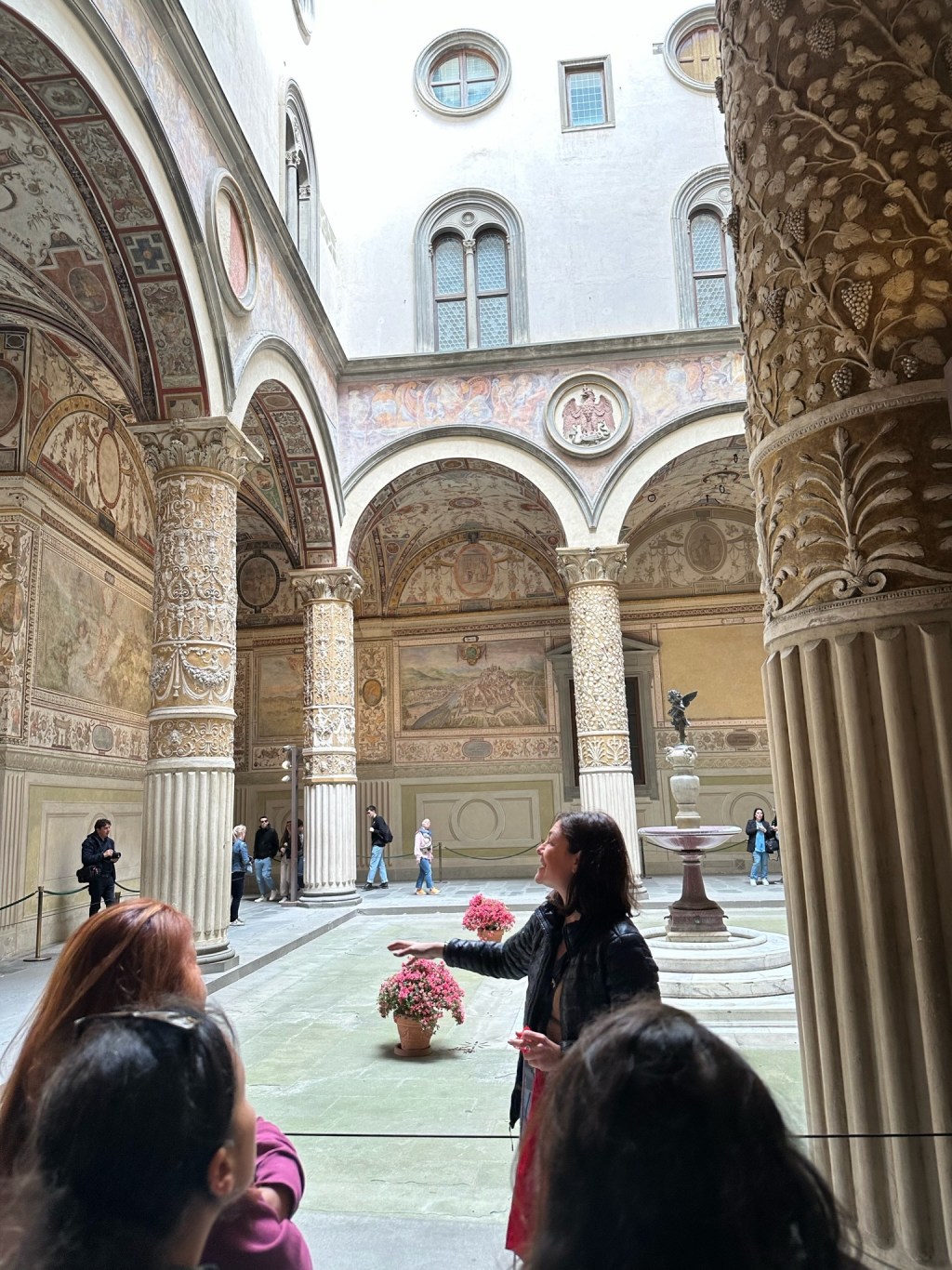
You can see it without a ticket, and it’s the best introduction to the palace. In 1565, for the wedding of Cosimo’s son Francesco I to Joanna of Austria, the courtyard was covered in gilded stucco, grotesques and views of Habsburg cities such as Vienna and Prague, in honour of the bride.
In the centre is Verrocchio’s fountain with the boy and dolphin: the one here is a copy; the original is inside, in the museum.
The Hall of the Five Hundred
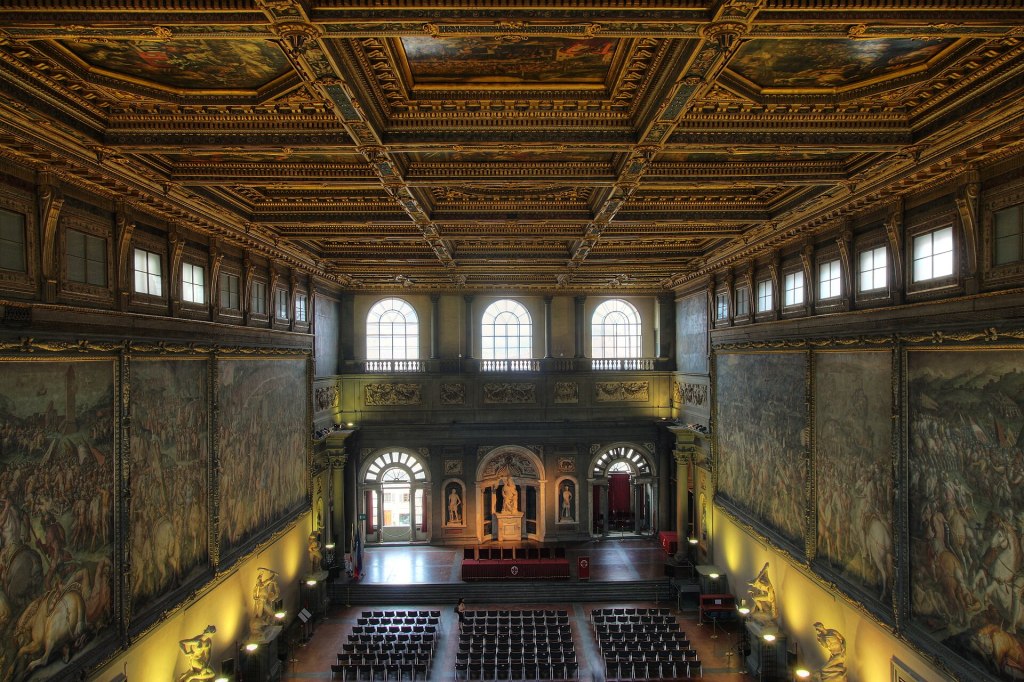
Cronaca built it in 1495 for the Great Council of Savonarola’s republic. Two battle scenes were commissioned for its walls from Leonardo and Michelangelo: Leonardo tried an experimental technique that failed, and Michelangelo’s never got beyond the cartoon.
Sixty years later Vasari raised the ceiling and turned it into the duke’s great hall. The scheme, devised by Vincenzo Borghini, is pure propaganda: on the walls, the war against Pisa, which took the republic fourteen years, faces the conquest of Siena, which took Cosimo fourteen months. In the centre of the ceiling, Cosimo I is crowned, surrounded by the coats of arms of the guilds.
Look for the little green flag with the words «Cerca trova» («seek and you shall find») in the Battle of Marciano, and Michelangelo’s Genius of Victory, intended for the tomb of Pope Julius II.
Three rooms you shouldn’t miss
The Studiolo of Francesco I
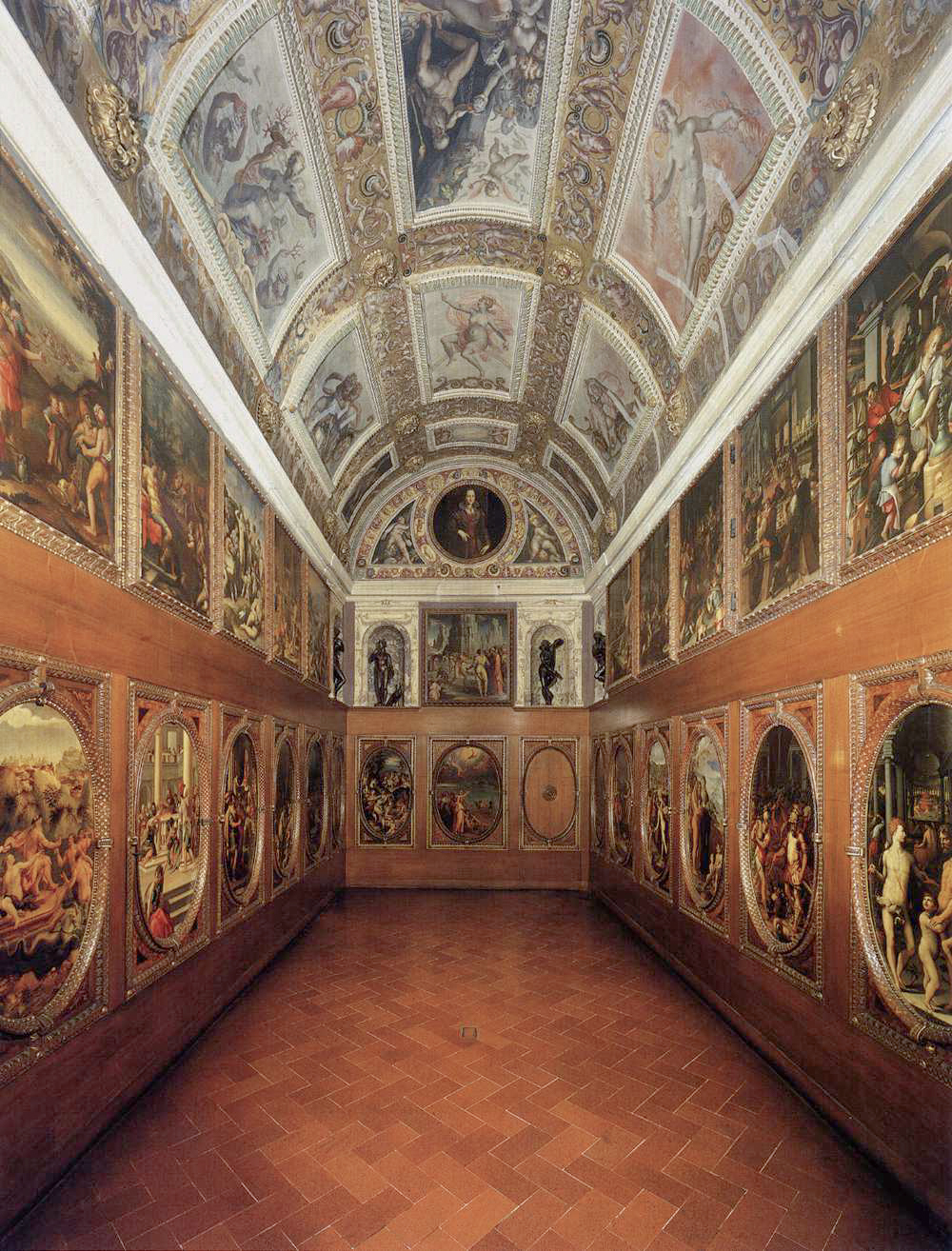
A windowless room (1570–1572) where Cosimo’s son, obsessed with alchemy, kept his treasures. Each painting is a cabinet door announcing what lay behind it: stones, crystals, pearls or bezoars, hairballs believed to neutralise arsenic. In the 18th century it was even used to store coal.
The Map Room
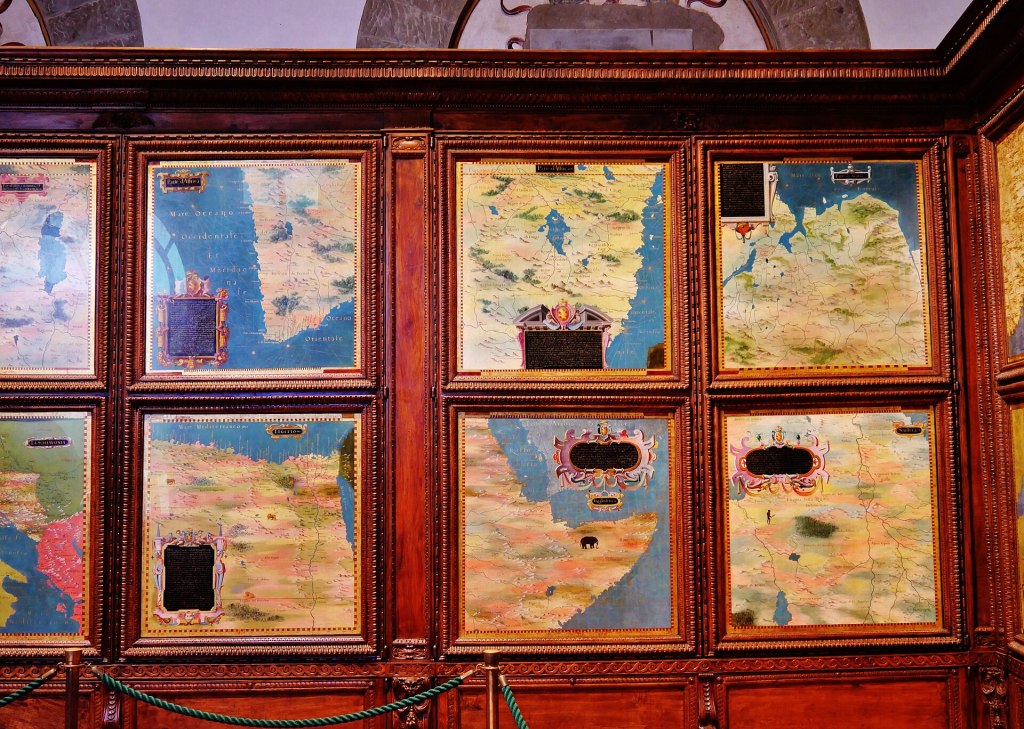
The Medici wardrobe: wooden cabinets with the known world painted on their doors by Ignazio Danti and Stefano Bonsignori, and a huge globe in the middle. Behind the map of Armenia hides a secret door.
The Hall of Lilies and Judith
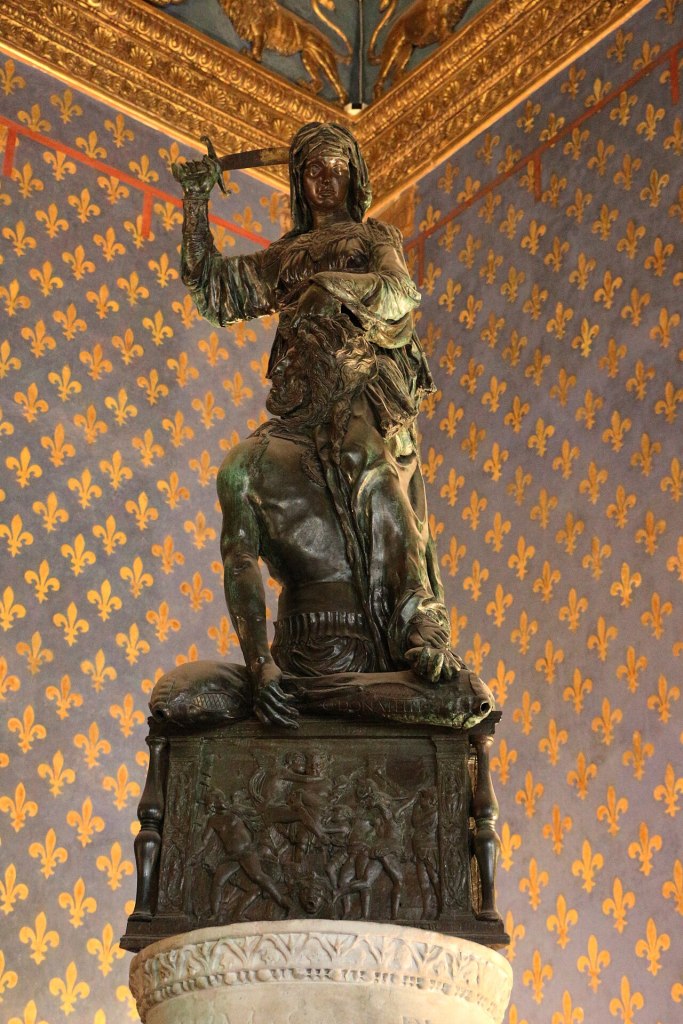
This is where you’ll find the original of Donatello’s Judith and Holofernes, brought into the museum in 1980 (the one in the square is a copy). It belonged to the Medici, but when the family was expelled in 1494 the republic placed it in front of the palace as a symbol of a city freeing itself from tyranny. Look too at the door to the Audience Hall, with Dante and Petrarch in inlaid wood.
And also…
- Cosimo I’s apartments: downstairs, rooms dedicated to the Medici; upstairs, in the Apartments of the Elements, rooms dedicated to the gods. Earthly rulers below, heavenly ones above.
- Eleonora of Toledo’s apartments, with the chapel painted by Bronzino and ceilings dedicated to wise and faithful women: the Sabines, Esther and Penelope.
- The Chancery, linked to Machiavelli, who worked in the palace as secretary to the republic.
- Arnolfo’s Tower: a narrow climb rewarded with one of the best views of the dome.
💡 Guide’s note: in 1527, during the uprising against the Medici, a bench thrown from a window of the palace broke the arm of the David, which then stood by the entrance. A very young Vasari picked up the pieces, and years later, under Cosimo I, the arm was restored.
Before you go
- The museum and the tower have separate tickets (the tower and battlements walk cost €20). If you want to do the tower, leave it until the end of your visit and have a plan B in case of rain: the battlements walk.
- The tower climb is all stairs: it isn’t accessible for people with reduced mobility and children under 6 aren’t allowed.
- Secret passages: the museum also runs guided tours with limited places, booked separately.
🗓️ Current exhibition: «I leoni di Firenze» (updated November 2026)
Until 18 January 2027, the Hall of Lilies, home to Donatello’s Judith, hosts an exhibition on the lion as a symbol of Florence’s power, freedom and identity. Check the official website to see whether the route or price changes.
Practical information updated in November 2026 from the Mus.E website and the official ticket office of Florence’s Civic Museums. Prices, free-entry rules and opening hours may change: always check musefirenze.it and bigliettimusei.comune.fi.it.
Shall we see it together?
A private tour of Palazzo Vecchio, room by room.
📖 Keep reading
Photos: Chiara Reale (square, courtyard and tower view), except Wikimedia Commons: Eusebius (CC BY 3.0, Hall of the Five Hundred), public domain (Studiolo), Zairon (CC BY 4.0, Map Room) and Sailko (CC BY 3.0, Judith).
★★★★★ 5.0 on Tripadvisor
over 100 reviews
Have you already taken a tour with me? A review takes a minute and really helps other travellers find me. Thank you!
Follow me on social media
@lugaresdeflorencia · Florence, unfiltered


Debe estar conectado para enviar un comentario.