

Almost everyone queues to climb the dome, and very few go into this museum, right behind the apse. That’s a shame, because the Museo dell’Opera del Duomo holds the original works from the Duomo, the Baptistery and the Bell Tower.
Many of the pieces you see in the square are copies: the real ones are inside, protected and at eye level. My advice: start here, and you’ll look at the cathedral with completely different eyes.
At a glance
- Museum opening hours: Daily, 8:30 am to 7 pm. ⚠️ Closed on the first Tuesday of the month. Allow an hour and a half.
- Tickets: The museum is included in all three Duomo passes: Ghiberti (€15), Giotto (€20) and Brunelleschi (€30), each valid for 3 days. There’s no museum-only ticket.
- Time slots: Not needed for the museum or the Baptistery. Each pass has just one monument with a compulsory time slot: the dome (Brunelleschi pass), the Bell Tower (Giotto) or the crypt of Santa Reparata (Ghiberti).
- The cathedral is free, with no ticket or booking: Monday to Saturday, 10:15 am to 3:45 pm. Closed on Sundays and religious holidays. Enter through the main façade door.
- Where: Piazza del Duomo 9. Official tickets: tickets.duomo.firenze.it · duomo.firenze.it.
From cathedral workshop to museum
The Opera di Santa Maria del Fiore was founded in 1296 to oversee the building of the new cathedral, and it still looks after the Duomo, the Baptistery, the Bell Tower and the crypt today. These rooms were its workshops, forges and storerooms: this is where the young Michelangelo carved the David.
In 1778, with the permission of Grand Duke Pietro Leopoldo, the building became a theatre, the Teatro degli Intrepidi. The museum opened in 1891, and on 29 October 2015 the new layout was unveiled, designed to give each work back the setting it was made for: the façade statues are back on a façade, the doors face their Baptistery.
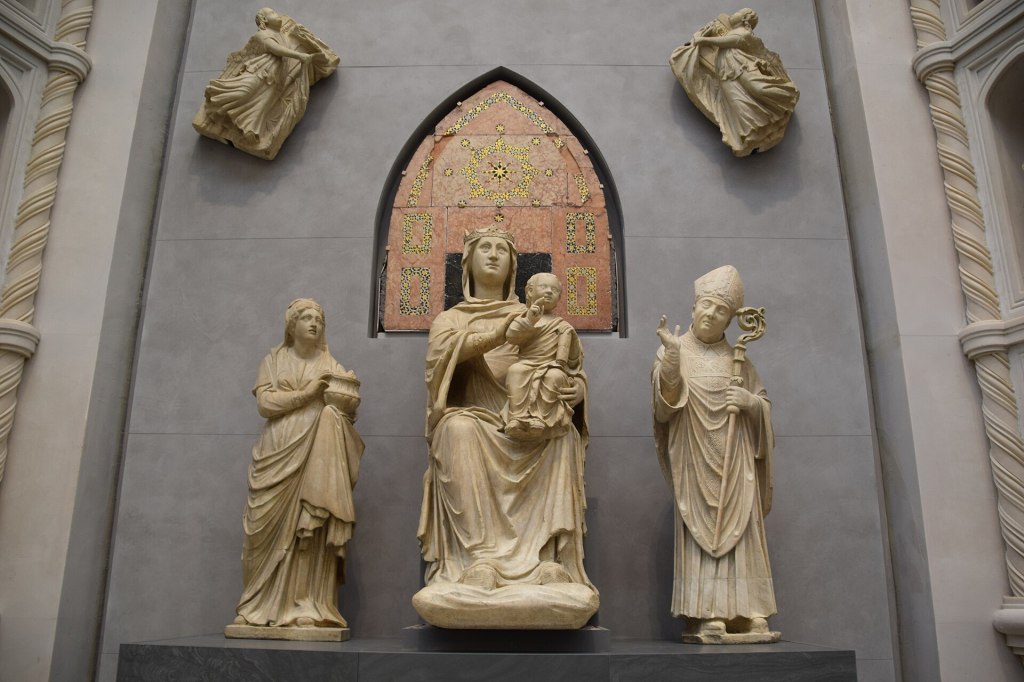
The Hall of Paradise
The most spectacular room recreates the space between the cathedral and the Baptistery, which Florentines called «paradise». On one side, full-size, is Arnolfo di Cambio’s façade, left unfinished and dismantled in 1587, with its original statues; opposite stand the Baptistery’s three bronze doors.
Look out for Arnolfo’s Madonna with the Glass Eyes: the glass, unusual in a marble statue, caught the evening light, so the Virgin seemed to watch over and bless everyone crossing the square.
Works you shouldn’t miss
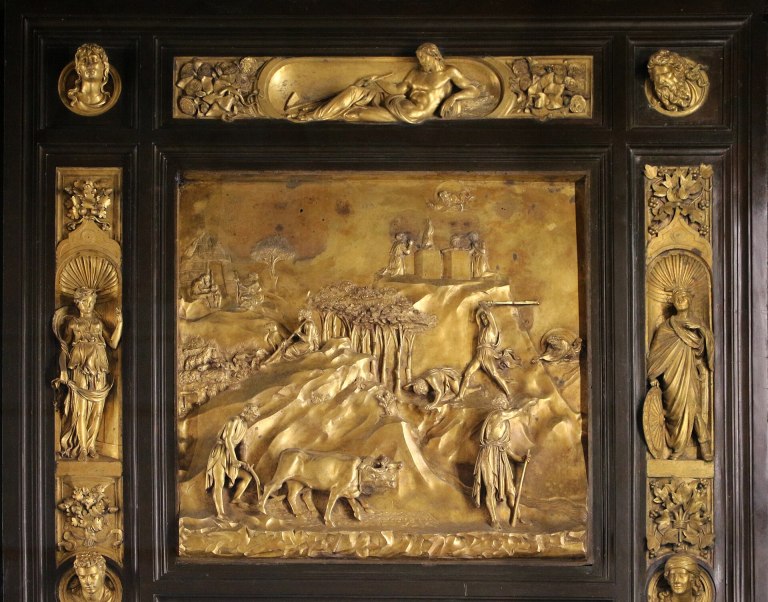
The Baptistery doors
Andrea Pisano’s (1330–1336), the first in bronze; Ghiberti’s north door, the outcome of the 1401 competition often seen as the start of the Renaissance; and the Gates of Paradise (1425–1452), where Ghiberti went from 28 small panels to 10 large ones in perspective. Look for his self-portrait among the heads on the frame.
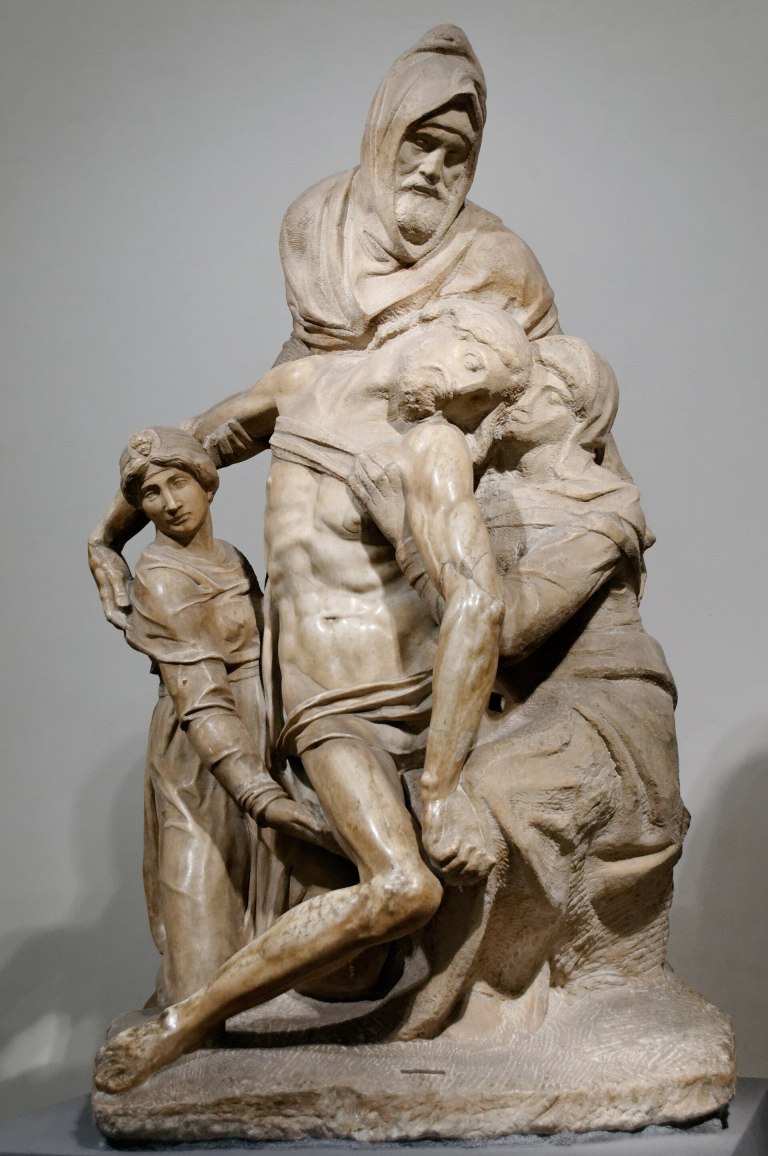
The Bandini Pietà
Michelangelo, by then an old man, carved it at night in Rome, with his own tomb in mind. Unhappy with Christ’s leg and with marble full of veins, in 1555 he struck it with a hammer and gave up on it. Nicodemus, the figure with the broken nose, is his self-portrait.

Donatello’s Magdalene
Painted poplar wood: a woman wasted by fasting, clothed only in her hair, her hands about to meet in prayer. Restoration after the 1966 flood revealed traces of gold in her hair.
And also…
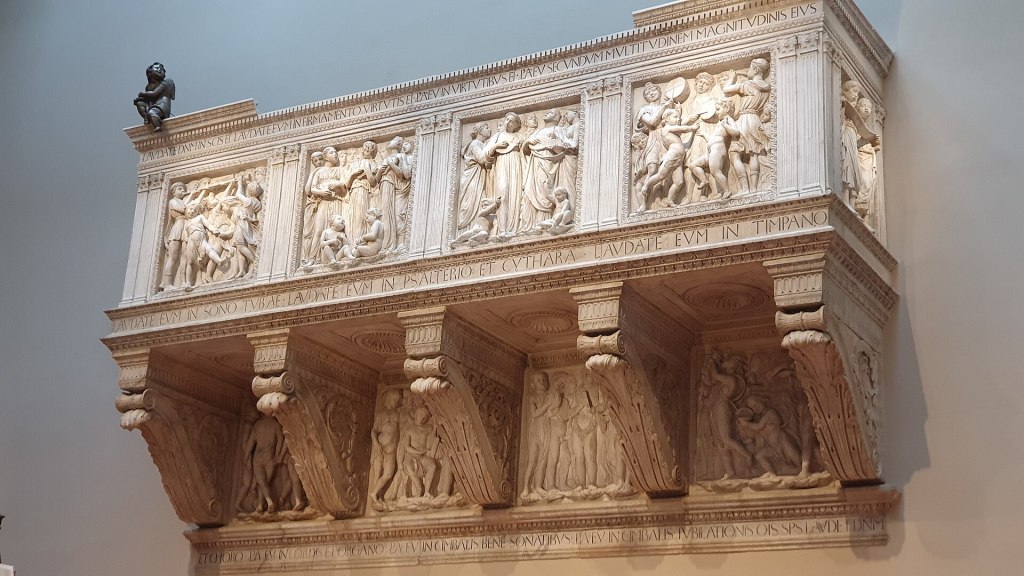
- The two cantorie, the marble singing galleries of the cathedral choir. On Luca della Robbia’s, children sing and play instruments reproduced in every detail; on Donatello’s they dance in a ring, among glass and gold mosaic pieces designed to sparkle in candlelight.
- The Bell Tower originals: 54 reliefs and 28 statues. Andrea Pisano’s hexagonal panels show the trades of mankind, from the simplest to the most complex; higher up are Donatello’s prophets.
- The dome gallery: the wooden model of the lantern, Brunelleschi’s death mask and remains of the machines that hoisted the materials.
- The terrace, with the dome almost within reach.
💡 Guide’s note: on your way out, look at the base of the dome. Only one of its eight sides has Baccio d’Agnolo’s marble gallery: according to tradition, Michelangelo called it «a cage for crickets» and work stopped for good. And the façade you see today, from the 19th century, was chosen almost by popular vote: both options for the top were built in wood and Florentines had their say.
Which pass should I choose?
- Ghiberti pass (€15): Baptistery, museum and the crypt of Santa Reparata. Time slot for the crypt only.
- Giotto pass (€20): All of the above plus the Bell Tower. Time slot for the Bell Tower (and the crypt).
- Brunelleschi pass (€30): Every monument, dome included. Time slot for the dome only: you can climb the Bell Tower without booking within the 3 days. ⚠️ It’s personal: you’ll be asked for ID.
- Validity: 3 consecutive days from the date you choose, with one entry per monument. The museum and the Baptistery need no time slot.
- Cathedral: Free, no pass needed. With a pass, go in through the Porta del Campanile (south side); without one, through the façade door.
Shall we see it together?
Private tour of the cathedral and the museum.
📖 Keep reading
Information checked in November 2026 on the official website of the Opera di Santa Maria del Fiore (duomo.firenze.it). Opening hours, prices and rules may change: always check there before you go. Photos: Chiara Reale (dome) and Wikimedia Commons: George M. Groutas (CC BY 2.0), Sailko (CC BY 3.0), Marie-Lan Nguyen (CC BY 2.5), MenkinAlRire (CC BY-SA 4.0) and Yair Haklai (CC BY-SA 4.0).
★★★★★ 5.0 on Tripadvisor
over 100 reviews
Have you already taken a tour with me? A review takes a minute and really helps other travellers find me. Thank you!
Follow me on social media
@lugaresdeflorencia · Florence, unfiltered


Debe estar conectado para enviar un comentario.